How to Get Rid of Carpet Odour from Water Damage (Complete Guide)

how to get rid of carpet odor from water damage

Water damage is stressful enough without adding a persistent, foul smell to the mix. Whether your carpet got soaked from a burst pipe, a roof leak, or flooding during a Melbourne storm, the odour that follows isn’t just unpleasant — it’s a warning sign that biological processes are underway beneath your feet.

The good news? If you act quickly and methodically, you can get rid of carpet odour from water damage — and in many cases, save your carpet entirely. This guide walks you through exactly what causes the smell, how to address it step by step, and how to know when the damage has gone beyond what a DIY fix can handle.

Why Does Water-Damaged Carpet Smell?

Before you can fix the problem, it helps to understand what you’re actually dealing with. That distinctive musty, sour, or mildewy smell isn’t just damp fabric — it’s the result of several overlapping processes:

Bacteria and microbial growth. Wet carpet fibres and the underlay beneath them become a breeding ground for bacteria within hours of saturation. As these organisms multiply, they produce volatile organic compounds (VOCs) that are responsible for the characteristic odour.

Mould and mildew. Mould can begin forming in wet carpet within 24 to 48 hours in warm conditions — and Melbourne’s humidity in certain months accelerates this significantly. Once mould takes hold in carpet fibres or the underlay, the smell intensifies and becomes harder to eliminate without professional treatment.

Pre-existing contaminants. Carpets that were previously clean will still release dirt, oils, and organic matter when saturated. This “reactivation” of old residue adds another layer to the smell.

The water source matters. This is an important distinction that affects your entire approach.

Clean Water vs Contaminated Water: Why the Source Matters

Not all water damage is equal, and the type of water involved determines how aggressive your response needs to be.

Category 1 — Clean water (broken supply pipes, overflowing sinks, rainwater): Less biologically hazardous but still requires fast action. Odour from Category 1 damage is largely about speed of drying.

Category 2 — Grey water (washing machine overflows, dishwasher leaks, mild flooding): Contains mild contaminants. Carpet can often be salvaged with proper disinfecting and drying, but the risk of mould is higher.

Category 3 — Black water (sewage backup, floodwater from outside, heavily contaminated sources): This is a health hazard. Carpet and underlay saturated with black water should almost always be removed and replaced rather than cleaned — the risk of illness from residual contamination is not worth taking.

If you’re unsure which category your water event falls into, our IICRC-certified team can assess the situation and give you an honest recommendation.

Step-by-Step: How to Remove Carpet Odour from Water Damage

Here’s the process — in order. Skipping steps or going out of sequence is the most common reason odour returns after you think the problem is solved.

Step 1: Remove Standing Water Immediately

Time is your most important resource in water damage situations. Every hour of saturation increases biological activity and deepens the smell.

If it’s safe to do so, use a wet/dry vacuum (shop vac) to extract as much standing water as possible from the carpet surface. Don’t use a regular household vacuum — it will be destroyed by the water and won’t extract effectively.

If the volume of water is significant — anything beyond a small isolated spill — contact a professional restoration company immediately. We carry truck-mounted extraction equipment that removes water at a rate no household appliance can match.

Step 2: Extract Moisture from the Fibres and Underlay

The surface may appear to dry relatively quickly, but the underlay beneath your carpet can hold several times its weight in water. This is where most of the bacterial and mould activity occurs — and where the smell is generated.

Proper moisture extraction requires:

  • Multiple passes with extraction equipment over the affected area
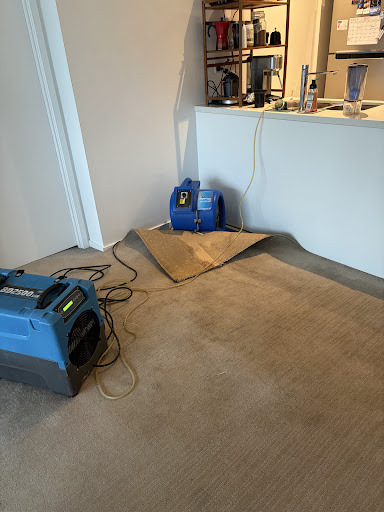
  • Lifting the carpet where possible to address the underlay directly
  • Checking moisture levels with a moisture meter, not just by feel

This step is where professional intervention makes the biggest difference. Our extraction equipment removes 95%+ of the moisture that a shop vac would leave behind.

Step 3: Set Up Aggressive Airflow and Dehumidification

After extraction, the remaining moisture must be evaporated and removed from the air. This requires:

Air movers positioned to push air across the carpet surface at a specific angle. Standard fans can help but are significantly less effective than commercial air movers.

Dehumidifiers to pull the evaporated moisture out of the room. Without dehumidification, you’re essentially moving moisture from the carpet into the ambient air — and it will settle back.

In Melbourne, where humidity can be high depending on the season, dehumidification is especially important. Keep windows closed during this process if outside humidity is higher than inside.

Target: carpet should be dry to the touch within 24–48 hours for light damage. Deeper saturation may take 3–5 days with the right equipment.

Step 4: Disinfect the Carpet

Once moisture is under control, bacteria and any early-stage mould need to be addressed before they have a chance to fully establish. Use an appropriate antimicrobial solution designed for carpet — not bleach, which can damage fibres and doesn’t address the full range of microorganisms involved.

Work the solution into the carpet fibres with a soft brush, allow the recommended dwell time, then extract any excess liquid. For contaminated water events, this step should be done by a professional with commercial-grade biocide solutions.

Step 5: Deodorise

With the bacteria addressed, odour treatment can begin. There are two main approaches:

Enzyme-based odour neutralisers — these break down the organic compounds causing the smell at a molecular level, rather than simply masking them. They are available at hardware and pet supply stores. Follow product instructions carefully; they require adequate dwell time to be effective.

Activated carbon or ozone treatment — for persistent, deep-seated odour, particularly where mould has been present. Ozone treatment in particular is highly effective but must be done correctly — it requires the space to be vacated during treatment.

Our team uses professional-grade enzyme and oxidation treatments that address odour sources rather than covering them.

When Does the Carpet Padding Need to Be Replaced?

This is where we have to be completely honest with you: in many water damage situations, saving the carpet but replacing the underlay is the right call.

Carpet padding is highly porous and holds moisture exceptionally well. It’s also very difficult to dry thoroughly without lifting the carpet. If the underlay has been wet for more than 24 hours, or if it has any visible mould growth or a strong smell even after the carpet above has been treated, replacement is almost always more cost-effective than trying to salvage it.

The good news is that replacing underlay is relatively affordable compared to replacing the full carpet. And doing it properly means the odour won’t come back six months later.

Prevention: Reducing the Risk of Future Odour Problems

You can’t always prevent water damage, but you can reduce the risk of odour becoming a major issue:

  • Act within the first hour wherever possible — the difference between 2 hours and 24 hours of saturation is enormous in terms of microbial growth
  • Keep a wet/dry vacuum accessible if your property is prone to flooding or pipe issues
  • Ensure adequate ventilation in wet areas (laundry, bathroom) to prevent moisture migration into adjacent carpeted rooms
  • Have carpets professionally cleaned annually — clean carpets with lower organic load dry faster and support less microbial growth after a water event

When to Call a Professional

DIY methods work well for very minor, clean-water incidents caught immediately. But in most water damage situations, professional intervention isn’t just helpful — it’s what actually resolves the problem.

You should call us if:

  • The affected area is larger than about 1–2 square metres
  • The water source was anything other than clean tap water
  • The carpet has been wet for more than a few hours
  • You can smell mould, or see any visible discolouration in the carpet or underlay
  • The smell persists despite your own drying and cleaning efforts

We’ve restored more than 5,000 Melbourne properties since 2007, and water damage odour is one of the most common problems we’re called in to fix. We can assess the situation honestly, tell you what’s salvageable and what isn’t, and get your home smelling like a home again.

Call The Squeaky Clean Team on 1300 682 563 — we’re available 24/7, including weekends and public holidays. For emergencies, we aim to be with you within 60 minutes.

Facebook
Twitter
LinkedIn