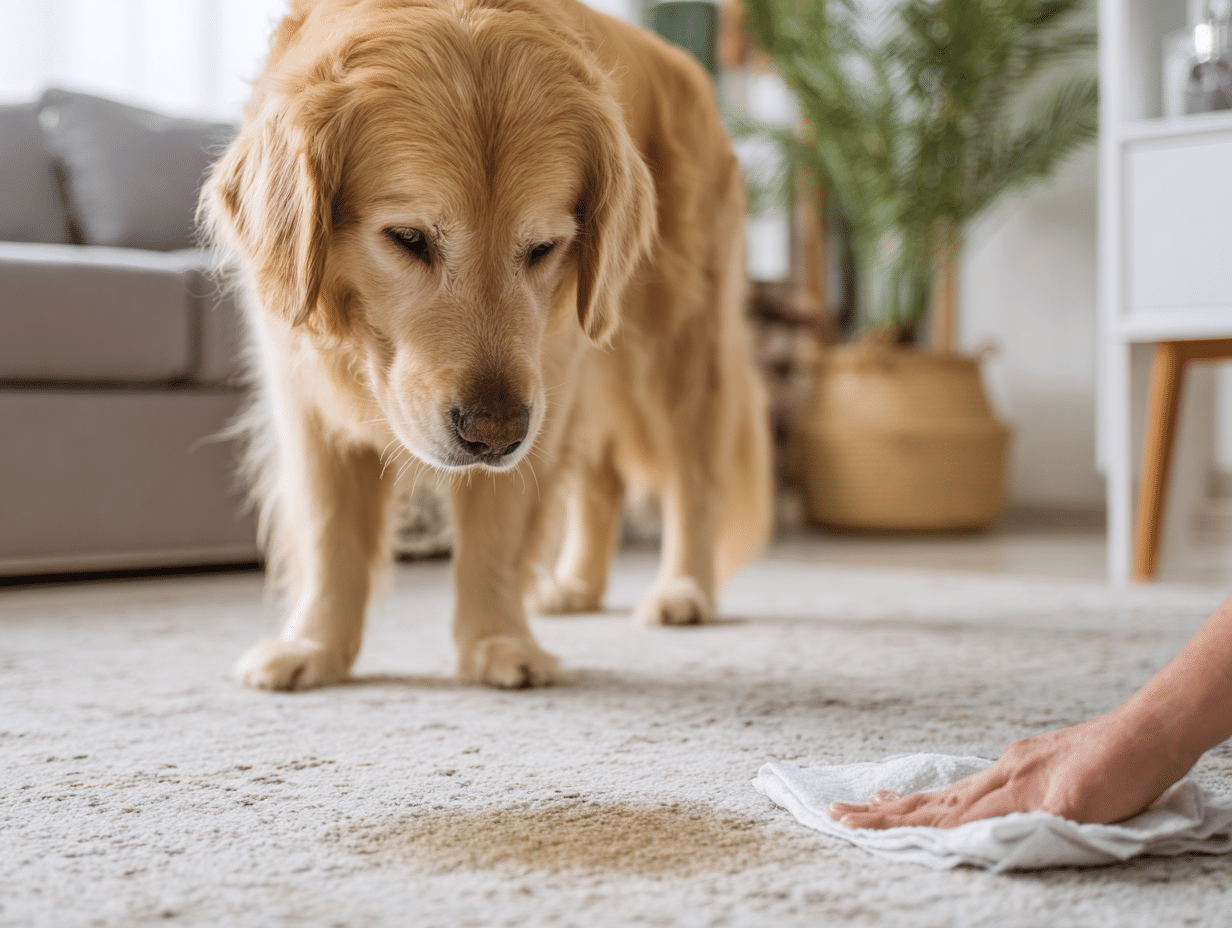
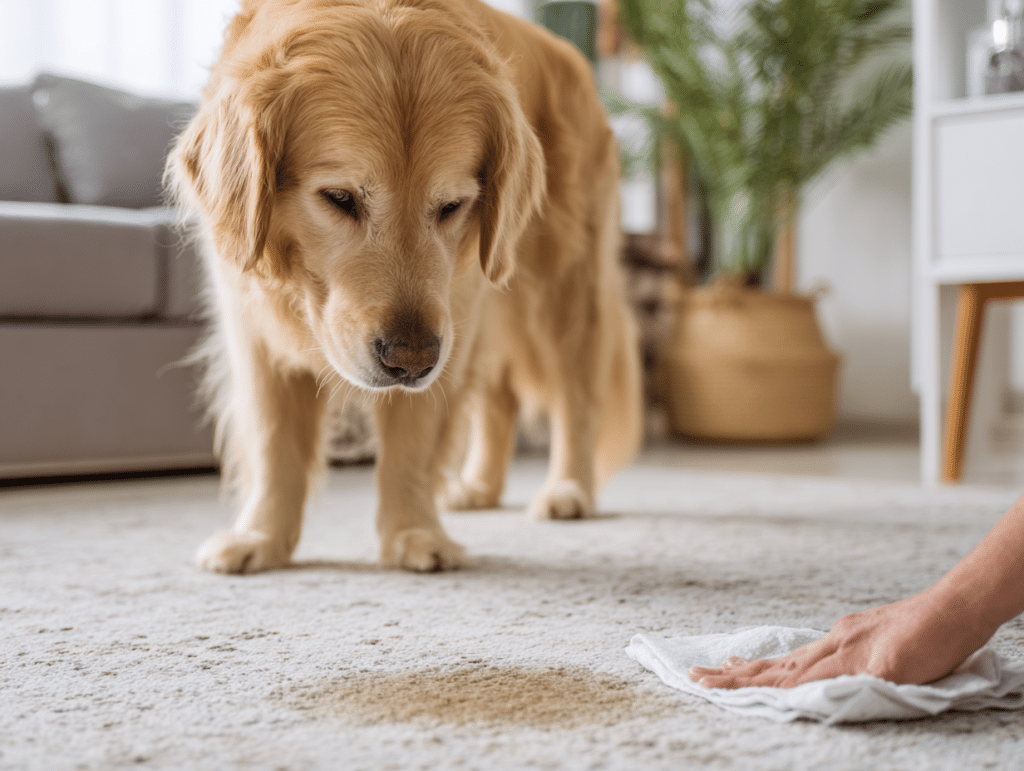
We’ve seen it all. If you’ve found a wet patch on the carpet — or worse, you’ve caught a whiff of something that has clearly been there a while — you’re in good company. Pet accidents happen in even the most well-trained households, and the key to handling them without lasting odour or staining is knowing exactly what to do and why.
Let’s be straightforward: dog urine on carpet is a solvable problem. But it does require the right approach. Here’s what actually works.
Why Dog Urine Odour Is So Persistent
Dog urine is a complex mix of urea, creatinine, urobilin, bacteria, hormones, and — crucially — uric acid. Uric acid is what makes pet urine odour so difficult to eliminate.
Uric acid forms crystals as urine dries, and these crystals bond to carpet fibres and underlay. Standard cleaning removes the surface components (urea, proteins), which is why the spot may look clean and smell temporarily okay — until moisture is introduced. When humidity rises, those uric acid crystals are reactivated and release the odour again.
This is why the classic cleaning mistake — scrubbing the spot with water and dish soap — often results in the smell returning. You’ve cleaned the surface, but the uric acid is still there.
The solution is enzyme-based cleaning, which we’ll get to shortly.
Fresh Stains: What to Do Immediately
Catch it fresh and you have a real chance of full removal. Here’s the sequence:
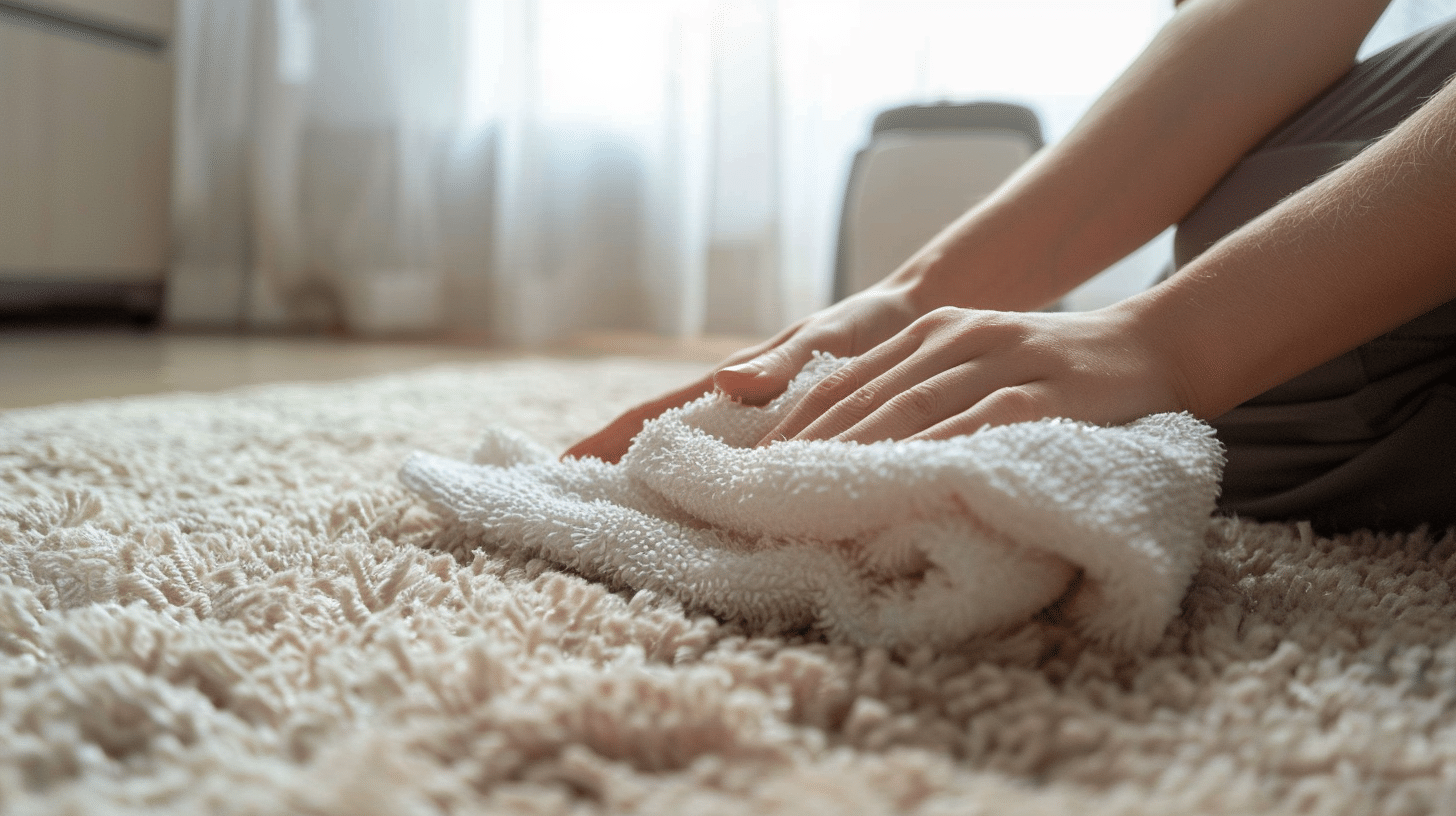
Step 1: Blot — do not rub. Use several layers of clean, white paper towel or a clean cloth. Press firmly onto the spot to absorb as much liquid as possible, working from the outside edges inward. Replace the towels as they become saturated. The goal is to remove as much urine as possible before it penetrates deeply into the fibres and reaches the underlay.
Step 2: Apply cold water. Pour a small amount of cold water onto the spot (not hot water — heat sets the stain and activates the odour compounds). Blot again with clean towels.
Step 3: Apply an enzyme cleaner. This is the critical step. See the section below for a full explanation. Apply the enzyme cleaner generously — it needs to penetrate to the same depth the urine reached, including into the underlay where possible.
Step 4: Allow adequate dwell time. Enzyme cleaners need time to work. Follow the product instructions, but most require at least 10–15 minutes. For a well-saturated spot, longer is better.
Step 5: Blot and allow to dry. Blot up the enzyme cleaner with clean towels, then allow the area to dry completely. Place a clean towel over the spot weighted down with something heavy to continue drawing moisture upward as it dries.
What not to do:
- Don’t use steam or hot water extraction immediately after an enzyme treatment — heat deactivates the enzymes
- Don’t apply cleaning products before the enzyme treatment — some will react badly with the enzymes or lock in the uric acid
- Don’t let your dog back onto the spot until it’s fully dry and odour-free — dogs will re-mark areas they can still smell
Enzymatic Cleaners: What They Are and How They Work
Enzyme-based cleaners contain specific strains of beneficial bacteria that produce enzymes targeting the biological compounds in pet urine. The enzymes break down uric acid, urea, and other organic compounds at a molecular level — not masking the smell, but eliminating its source.
Choosing an enzyme cleaner:
- Look for products specifically designed for pet urine (not a general enzyme cleaner)
- Check that the product targets uric acid specifically — some general enzyme cleaners are formulated for different organic compounds
- Most pet and vet supply stores stock good options — popular Australian brands are widely available at Petbarn, Woolworths and Bunnings
Using enzyme cleaners effectively:
- Apply generously — the solution must reach the same depth as the urine
- Allow the full recommended dwell time
- Keep the area moist during dwell time (cover with a damp cloth or plastic wrap) — enzymes work in the presence of moisture
- Do not use disinfectants or antibacterial sprays immediately before or after — these will kill the beneficial bacteria in the enzyme solution
Old and Dried Stains: A Different Approach
If the accident wasn’t caught immediately, or if you’ve discovered a stain that’s clearly been there a while (possibly from a previous pet, or found under furniture), the approach is a little different.
Locate all affected areas first. In a dark room with a UV (black light) torch — available cheaply online or at hardware stores — dried urine fluoresces visibly. You may find the affected area is significantly larger than the visible stain. Treat the full area, not just the discolouration.
Re-wet the area first. Apply cold water to the dry stain to rehydrate the uric acid crystals, making them more accessible to the enzyme cleaner. Blot up the excess, then apply the enzyme treatment.
Repeat applications. Old stains almost always require multiple enzyme treatments. Don’t expect a single application to resolve a stain that’s been there for months.
Stubborn cases. For old stains that haven’t responded to multiple enzyme treatments, professional equipment can inject cleaner deeper into the carpet and extract more effectively than any surface application. It’s also worth considering whether the underlay beneath the spot is permanently contaminated — in some cases, replacing the affected underlay section is the most practical solution.
Preventing Re-Marking
Dogs return to spots they’ve marked — even after cleaning. Their sense of smell is far more sensitive than ours, and if any uric acid crystals remain, they’ll be drawn back.
The most effective prevention:
- Ensure the enzyme treatment has fully eliminated the odour — confirm this by getting close to the carpet surface yourself (not just standing over it)
- Allow the area to dry completely before your dog has access to it
- Use a pet-safe enzymatic odour neutraliser as a final spray
- For persistent re-marking in the same spot, restrict your dog’s access to the area until the odour has been fully eliminated — dogs return to spots they can still smell, even faintly
What About Cat Urine?
Cat urine presents a particular challenge — it is significantly more concentrated than dog urine, and the smell is notably more pungent due to higher levels of protein and felinine (a sulphur-containing compound).
The same enzyme-based approach applies, but with cat urine you generally need:
- A longer enzyme dwell time (30+ minutes is often more effective than the minimum)
- Multiple treatment cycles for any stain that has been present more than a day or two
- More thorough extraction, particularly when the underlay is involved
One practical complication with cats: they are skilled at hiding their accidents. A UV light is even more valuable for locating cat urine stains, as cats will often choose corner spots, under furniture, or behind objects rather than the open areas dogs tend to use.
If you have a cat that is urinating outside the litter box habitually, it’s worth speaking with your vet — it often indicates a health or stress issue — alongside addressing the carpet. A carpet that retains residual urine smell even after cleaning can reinforce the behaviour.
Protecting Your Carpet Against Future Pet Accidents
Once you’ve addressed the current situation, a few preventive measures are worth putting in place:
Regular professional cleaning. This is the single most effective long-term strategy for pet households. Professional cleaning every 6–9 months removes the accumulation of pet dander, body oils, and general activity tracked across the carpet before it builds into a chronic odour problem — even when there are no obvious accidents to address. A clean carpet is also easier and cheaper to maintain.
Training and management. If your dog is still in training or prone to accidents in specific areas, consider washable area rugs over carpet in those zones — they can be taken outside and washed far more easily than fixed carpet.
Enzyme cleaner stock. Keep a bottle of enzyme cleaner on hand at all times. The single biggest factor in whether an accident leaves a permanent odour is how quickly it was treated. A 10-minute response is dramatically more effective than a same-day response.
A note on wool rugs specifically. Urine in a wool rug is one of the situations where standard on-site cleaning often falls short. Wool holds uric acid deeply within its fibres, and the gentle care required to avoid damaging the rug limits how aggressively it can be treated in place. If you have a wool rug that has been affected by pet urine, ask us about our rug laundry service — your rug is collected and given a specialist deep wash off-site that can penetrate the full depth of the pile and achieve results that in-home cleaning simply cannot.
When to Call a Professional
Professional pet odour treatment makes sense when:
- The accident wasn’t caught quickly and the urine has reached the underlay
- Multiple DIY attempts haven’t resolved the smell
- You have a UV light and can see the stain is much larger than the visible spot
- The carpet is high-value or the affected piece is a rug
- There are multiple old stains from a previous owner or previous pet
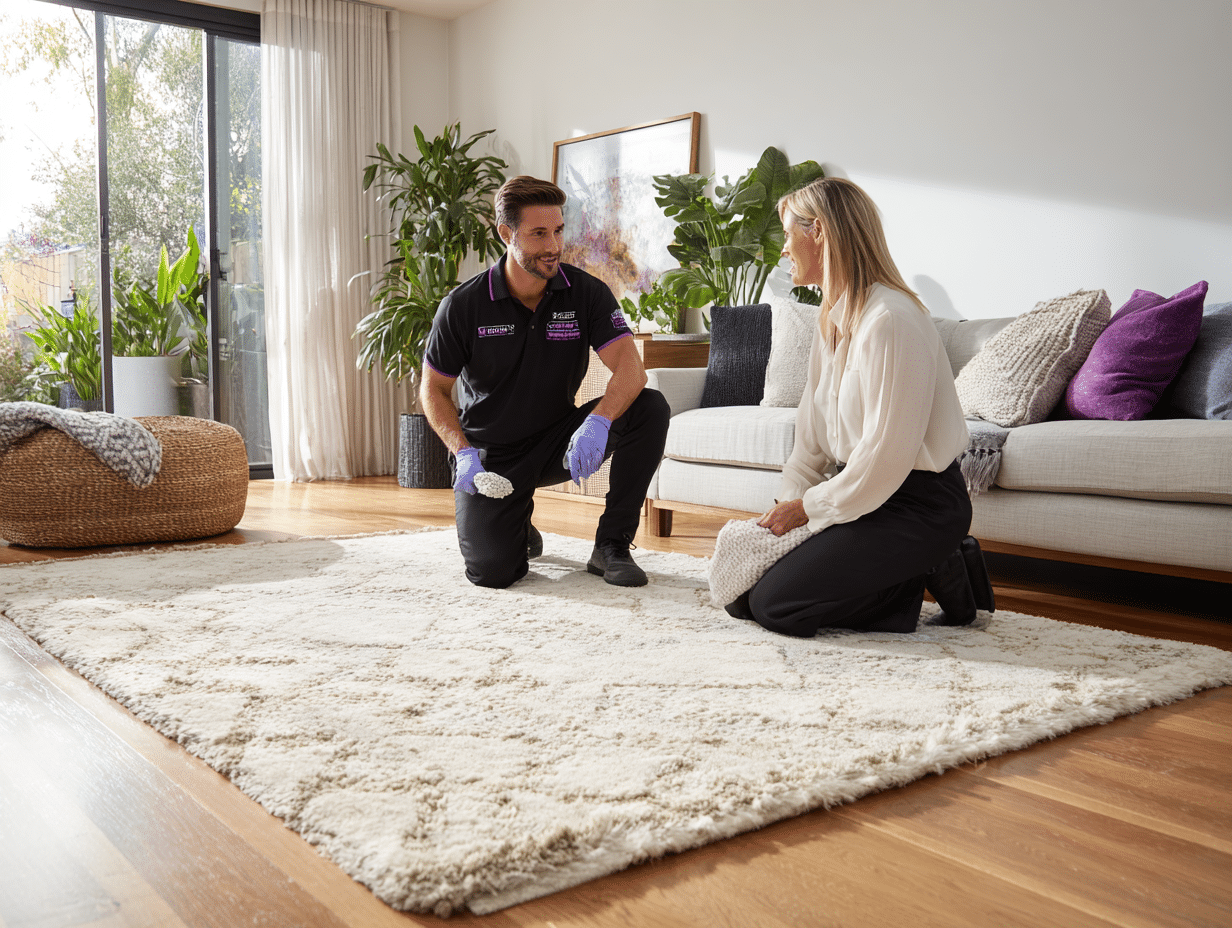
Our professional pet odour treatment uses commercial-grade enzyme solutions combined with extraction equipment that injects the treatment deep into the carpet and underlay, then removes both the cleaning solution and the dissolved contaminants. For severe cases, we may recommend sub-surface treatment — where we lift the carpet, treat the underlay and the floor beneath, and replace the underlay section if necessary.
A special note on wool rugs and other high-value pieces. Urine odour in wool rugs is particularly stubborn — wool’s natural structure holds uric acid deeply, and cleaning on-site with standard carpet equipment rarely achieves a complete result. For these situations, we offer a dedicated rug laundry service. Your rug is collected, taken off-site, and given a specialist deep wash that penetrates the full thickness of the pile and backing — something that simply isn’t possible with in-home carpet cleaning tools. It’s a more involved service and priced accordingly, but for a wool rug with a serious urine problem, it delivers results that on-site cleaning can’t match. Ask us about this when you call.
We don’t judge — we’ve honestly seen everything over more than 50 years of combined experience. What we care about is getting your home smelling fresh again.
Call The Squeaky Clean Team on 1300 682 563 or book online at squeakycleanteam.com.au. We service all Melbourne suburbs and can usually book within 1–2 days for non-emergency appointments.